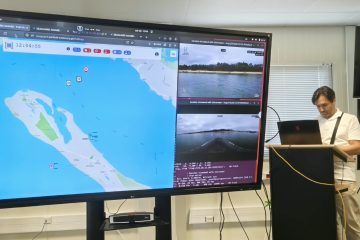
PARTICLE deliveres an oral communication on “Improving NPS investigation collaboration capabilities through a standardised interoperable API” at the FORENSICS 2026, 18th-22nd October PORTUGAL.
On October 21st 2026, Marco Manso (from PARTICLE) delivered an oral communication on “Improving NPS investigation collaboration capabilities through a standardised interoperable API” resulting from work developed in the NARCOSIS Project.
The communication stated by explaining the problematic around new psychoactive substances (NPS) and illicit drugs, which is raising great concerns in public health, given their harmful effects and health risks in consumers. As defined by the United Nations Office on Drugs and Crime (UNODC), a NPS is a “substance of abuse, either in a pure form or a preparation, that is not controlled by the 1961 Single Convention on Narcotic Drugs or the 1971 Convention on Psychotropic Substances, but which may pose a ‘public health threat’” [1].
Based on the European Drug Report for 2026 [2], 1050 NPS were reported since 2025 with about 400 NPS being detected in seizures in 2024. NPS are designed to evade legislation, thus it is fundamental that authorities implement fast processes for their detection, identification, characterization and reporting so that legal controls can be set in place.
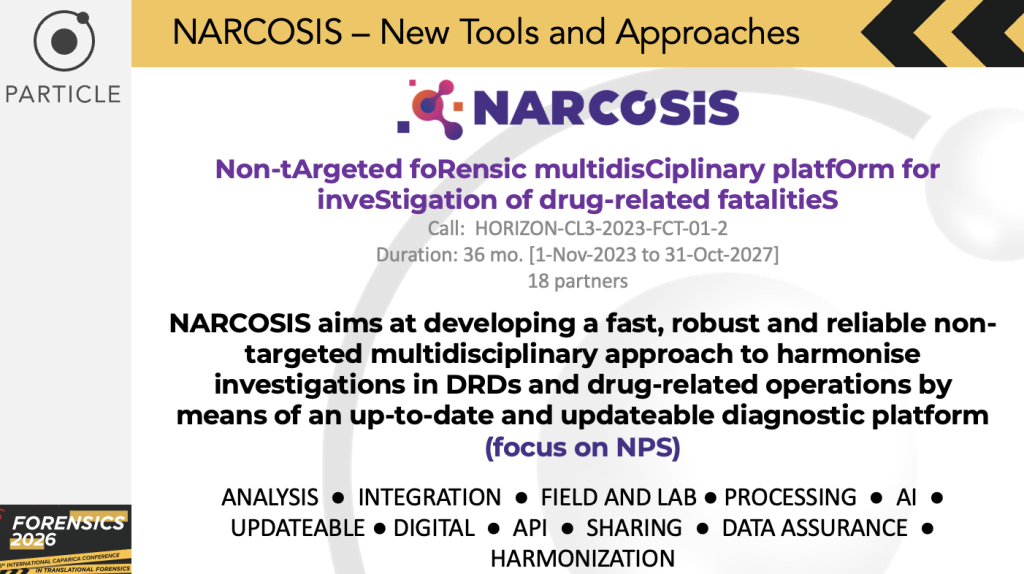

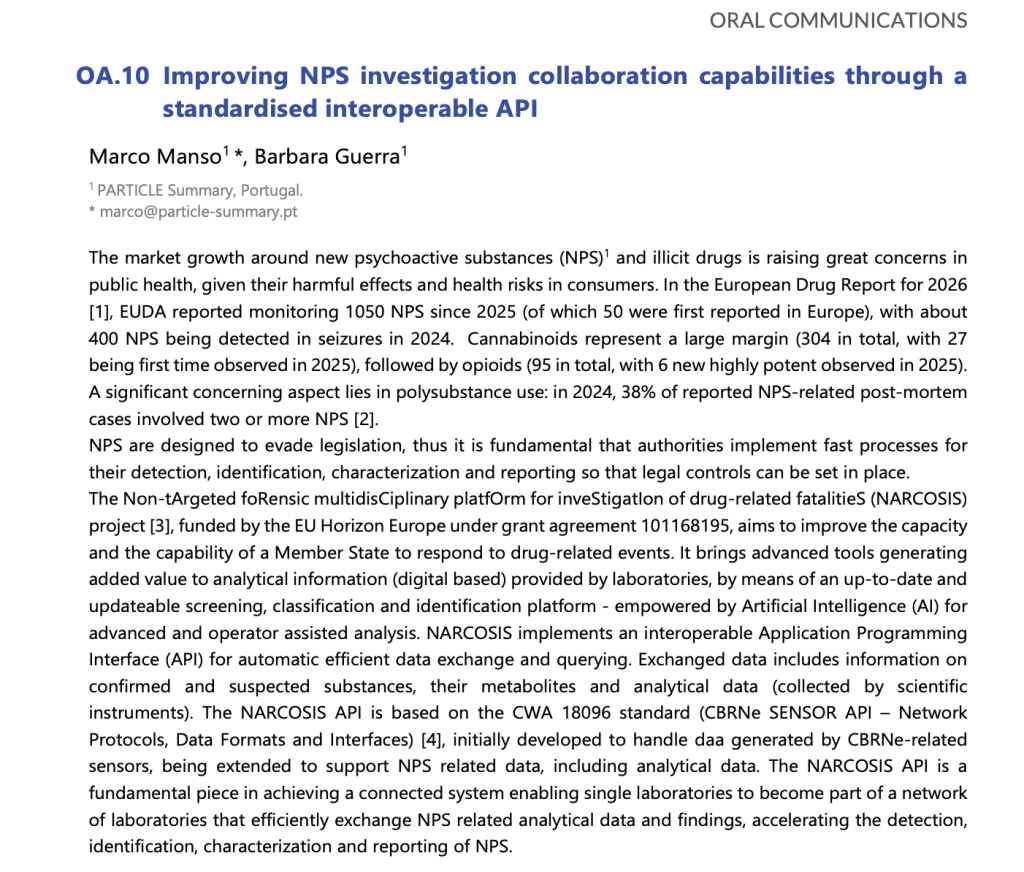
The communication then followed by presenting the NARCOSIS project [3], funded by the EU Horizon Europe under grant agreement 101168195. It was explained that NARCOSIS aims to improve the capacity and the capability of a Member State to respond to drug-related events. It brings advanced tools generating added value to analytical information (digital based) provided by laboratories, by means of an up-to-date and updateable screening, classification and identification platform – empowered by Artificial Intelligence (AI) for advanced and operator assisted analysis.
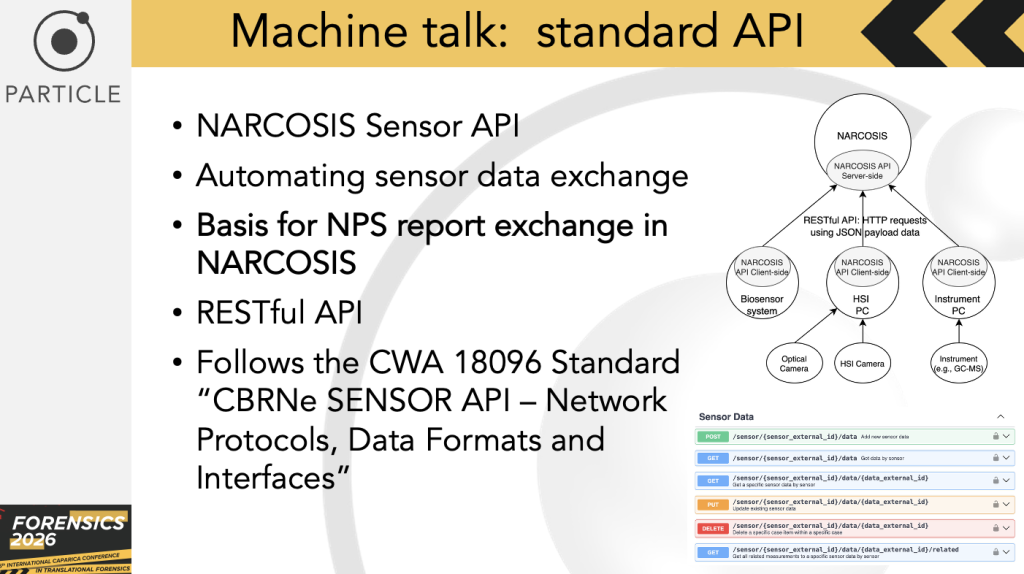
Digital was mentioned as a critical enabler for achieving efficiency and AI. For purposes of information exchange and querying, it was presented the NARCOSIS API, an interoperable Application Programming Interface (API) based on the standard CWA 18096 (CBRNe SENSOR API – Network Protocols, Data Formats and Interfaces) [4]. The API was initially developed to handle data generated by CBRNe-related sensors, and was extended to support NPS related data, including analytical data. It is a fundamental piece in achieving a connected system enabling single laboratories to become part of a network of laboratories that efficiently exchange NPS related analytical data and findings, accelerating the detection, identification, characterization and reporting of NPS.
References
[1] United Nations Office on Drugs and Crime (UNODC) online page: https://www.unodc.org/lss/page/nps
[2] EUDA. New psychoactive substances – the current situation in Europe (European Drug Report 2026). Last update: 9 June 2026. Available at: https://www.euda.europa.eu/publications/european-drug-report/2026/new-psychoactive-substances_en
[3] NARCOSIS Website: https://www.narcosis-project.eu/
[4] CENELEC. CWA 18096. CBRNe SENSOR API – Network Protocols, Data Formats and Interfaces. April 2024. https://www.cencenelec.eu/media/CEN-CENELEC/CWAs/RI/2024/cwa18096_2024.pdf
Related Articles