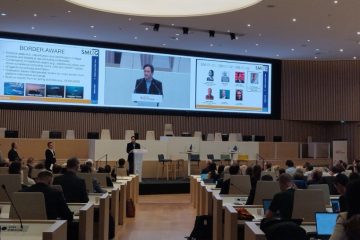
On November 4th 2025, Marco Manso (from PARTICLE) presented the IST-201 paper “Efficient Digital Voice and Chat Communications through Generative AI at the Tactical Edge” at the 30th edition of the International Command and Control Research Technology Symposium, hosted by the Swedish Defence University in collaboration with the Swedish Defence Research Agency and organised by the International Command and Control Institute. Gathering almost 200 experts in the command and control domain for four days, this is one of the world’s premier scientific conferences on topics related to Command and Control.
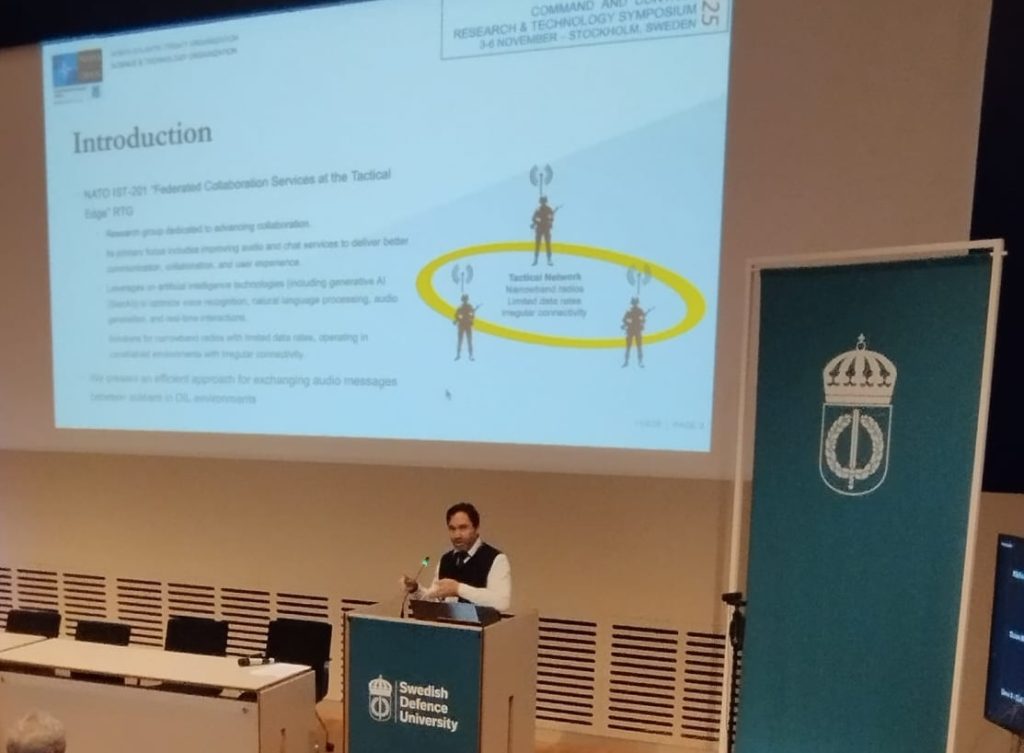
ICCRTS acknowledges the relevance of continuously innovating the implementation of command and control considering today’s challenging world.
The research scope of IST-201 in the context of tactical communications focuses on developing solutions for narrowband radios with limited data rates, operating in constrained environments with irregular connectivity. This is particularly crucial in military settings where soldiers need reliable voice communication in challenging conditions. The group aims to enhance communication systems that can operate effectively despite bandwidth limitations and sporadic connectivity, ensuring that voice communications remain clear and continuous in tactical environments.
Realized as part of IST-201 activities, this paper presents an efficient approach for exchanging audio messages between soldiers, particularly in environments with limited connectivity.
The paper discusses the design and architecture of next-generation collaboration services, where AI empowers the application to provide text-to-speech and speech-to-text capabilities, connected via an efficient message distribution mechanism.
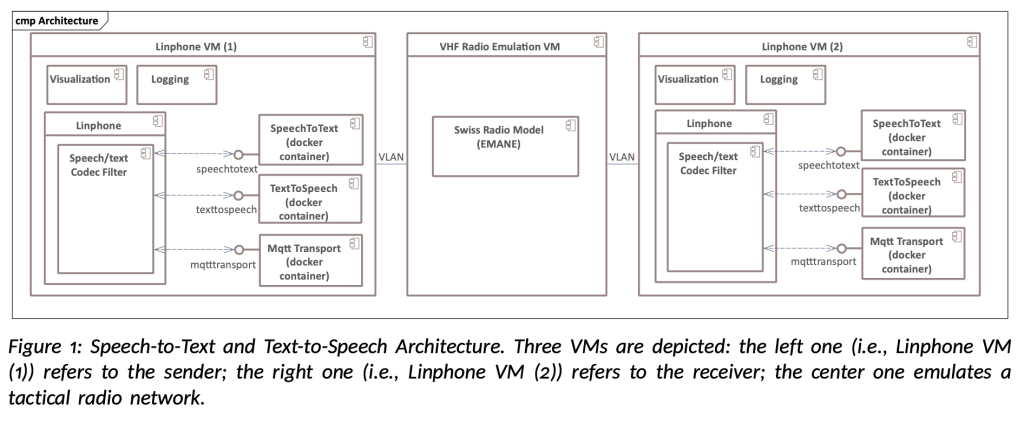
To achieve a realistic and immersive communication experience, it is introduced generative AI on the receiver side to reconstruct audio messages with characteristics similar to the original speaker.
The experimental results show that this approach significantly reduces the strain on tactical networks by lowering data rate requirements—achieving up to 93.7% reduction in transmitted media data compared to traditional voice codecs, and 72% reduction when including signaling overhead—while maintaining low end-to-end latency, typically under two seconds.
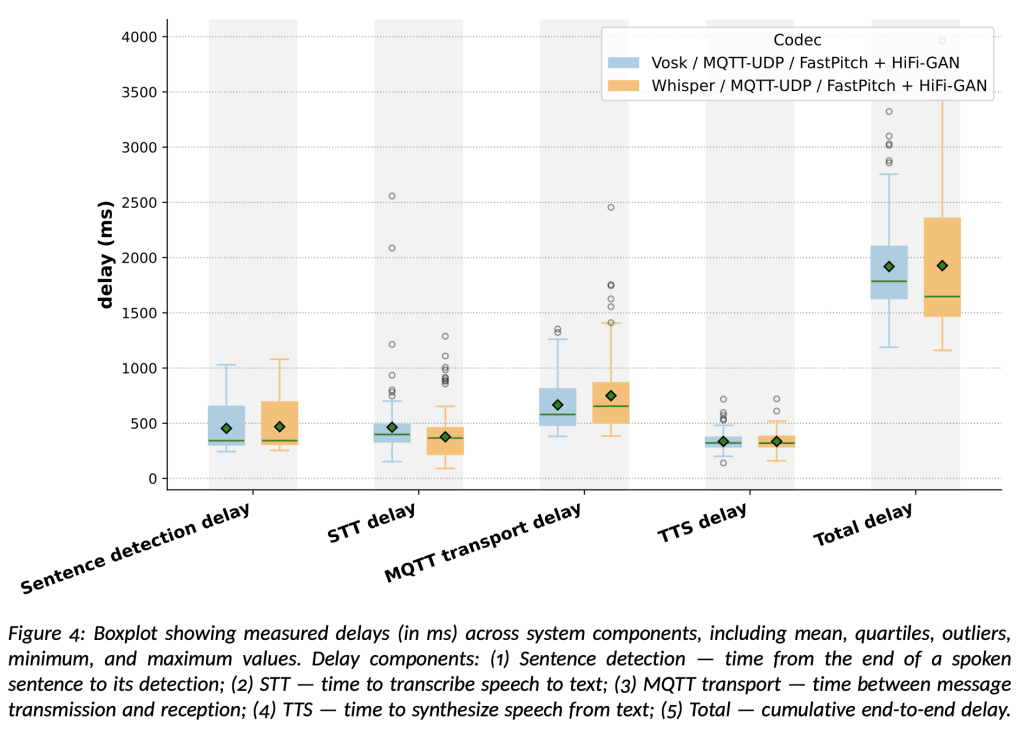
This work proposed a practical approach for enabling voice communication in constrained tactical networks by combining AI-based STT, efficient message transmission over MQTT/UDP, and high-quality GenAI TTS. The complete end-to-end pipeline maintained a total delay below two seconds, making it suitable for time-sensitive coordination in tactical operations. By transmitting short text messages instead of continuous audio streams, the system enables effective communication over narrowband, intermittent links typical of dismounted or contested environments. The solution is well suited for extension and scaling in NATO federated tactical networks and next-generation soldier systems.
Our next steps involve maturing and scaling-up the solution to be ready for operational use.
Access the full paper at ZENODO.
NATO IST-201 Group
This work was conducted as part of the NATO group IST-201.